United States
 United Kingdom
 Australia
 Europe
 Gulf countries
 India
IndiaHow To Find The Scale Factor Of A Rectangle
Understanding how shapes change size without changing their proportions is a core idea in geometry. One of the most practical examples of this concept is scaling a rectangle. Whether you are working on similarity problems, coordinate geometry, or real-world applications like maps and models, knowing how to find the scale factor of a rectangle helps you compare dimensions, predict measurements, and verify proportional relationships with confidence.
This guide explains the concept clearly, walks through multiple methods, and provides step-by-step examples so you can apply the idea correctly in exams and problem-solving situations.
What Is A Scale Factor
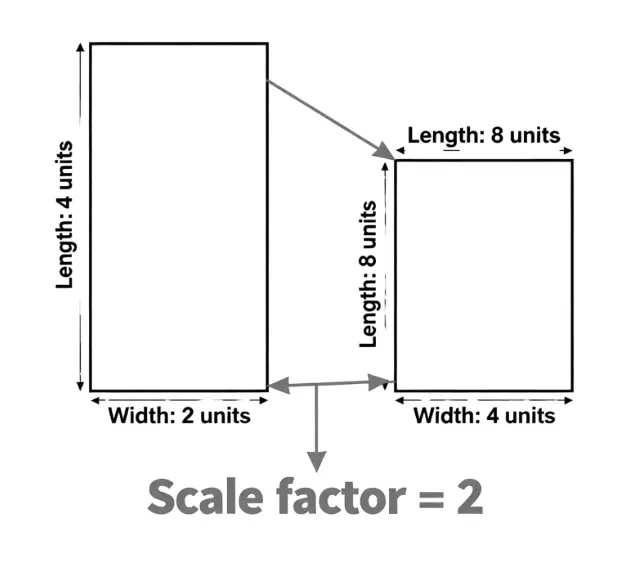
A scale factor is the number that describes how much a shape has been enlarged or reduced compared to its original size. When a rectangle is scaled, both its length and width change by the same ratio. The shape remains a rectangle, and its proportions stay consistent.
Key Idea
If every corresponding side of one rectangle is multiplied or divided by the same number to get another rectangle, that number is the scale factor.
- If the new rectangle is larger, the scale factor is greater than 1.
- If the new rectangle is smaller, the scale factor is between 0 and 1.
- If both rectangles are identical in size, the scale factor is 1.
Why Scale Factor Matters In Geometry
Students often encounter scale factors when studying:
- Similar figures
- Dilations in coordinate geometry
- Area and perimeter comparisons
- Map reading and model construction
- Ratio and proportion problems
Recognising scale relationships allows you to determine missing measurements quickly and verify whether two rectangles are similar.
Basic Formula To Find The Scale Factor Of A Rectangle
To determine how to find the scale factor of a rectangle, compare any pair of corresponding sides from the original and scaled rectangles.
Formula
Scale Factor = New Side Length ÷ Original Side Length
You may use either the length or the width, but you must compare corresponding sides only.
Method 1: Using Corresponding Side Lengths
This is the most direct approach and is commonly used in classroom problems.
Step-By-Step Process
- Identify the original rectangle and the scaled rectangle.
- Choose one pair of corresponding sides (length with length or width with width).
- Divide the measurement of the new rectangle by the measurement of the original rectangle.
- Confirm the same ratio works for the other pair of sides.
Example 1: Enlargement
Original rectangle:
Length = 4 cm
Width = 2 cm
Scaled rectangle:
Length = 12 cm
Width = 6 cm
Scale Factor = 12 ÷ 4 = 3
Check using width:
6 ÷ 2 = 3
Since both ratios match, the scale factor is 3. The rectangle was enlarged three times.
Example 2: Reduction
Original rectangle:
Length = 10 cm
Width = 8 cm
Scaled rectangle:
Length = 5 cm
Width = 4 cm
Scale Factor = 5 ÷ 10 = 0.5
Check using width:
4 ÷ 8 = 0.5
The scale factor is 0.5, meaning the rectangle was reduced to half its original size.
Method 2: Finding Scale Factor From Perimeter
Sometimes problems provide only the perimeters of two similar rectangles. Because perimeter changes linearly with scaling, you can still determine the scale factor.
Key Principle
If two rectangles are similar, the ratio of their perimeters equals the scale factor.
Formula
Scale Factor = New Perimeter ÷ Original Perimeter
Example
Original rectangle perimeter = 24 cm
Scaled rectangle perimeter = 36 cm
Scale Factor = 36 ÷ 24 = 1.5
The new rectangle is 1.5 times larger in each dimension.
Method 3: Finding Scale Factor Using Coordinates
In coordinate geometry, rectangles may be shown on a grid. To determine how to find the scale factor of a rectangle, compare distances between corresponding points.
Steps
- Measure the length and width of the original rectangle using coordinate distance.
- Measure the length and width of the image rectangle.
- Divide corresponding measurements.
Example
Original rectangle corners:
(0, 0), (2, 0), (2, 3), (0, 3)
Scaled rectangle corners:
(0, 0), (6, 0), (6, 9), (0, 9)
Original length = 2
New length = 6
Scale Factor = 6 ÷ 2 = 3
Original width = 3
New width = 9
Scale Factor = 9 ÷ 3 = 3
The scale factor is 3.
How Area Changes With Scale Factor
A common mistake is assuming area changes by the same ratio as side lengths. It does not. Area changes by the square of the scale factor.
Rule
New Area = Original Area × (Scale Factor)²
Example
Original rectangle area = 10 square units
Scale factor = 2
New area = 10 × 2² = 10 × 4 = 40 square units
Understanding this relationship helps students solve advanced geometry problems correctly.
Real-World Applications
Learning how to find the scale factor of a rectangle is not limited to classroom exercises. The concept appears in many practical contexts.
- Architecture And Design: Blueprints use scaled rectangles to represent rooms and structures accurately.
- Maps And Navigation: Maps reduce real distances using consistent scale factors.
- Digital Graphics: Images are resized using proportional scaling to maintain shape accuracy.
- Manufacturing And Models: Prototypes and scale models rely on exact scaling for precision.
Recognising scale relationships improves measurement accuracy in real situations.
Common Mistakes Students Should Avoid
- Comparing Non-Corresponding Sides: Always match length with length and width with width.
- Reversing The Ratio: Ensure you divide new measurement by original measurement unless instructed otherwise.
- Ignoring Units: Measurements must be in the same unit before calculating ratios.
- Forgetting To Verify Both Sides: Both pairs of sides must give the same scale factor for rectangles to be similar.
Practice Problems
Try these to reinforce your understanding of how to find the scale factor of a rectangle.
Problem 1
Original rectangle: 6 cm by 4 cm
New rectangle: 18 cm by 12 cm
Scale Factor = 18 ÷ 6 = 3
Problem 2
Original rectangle: 9 cm by 5 cm
New rectangle: 3 cm by 5/3 cm
Scale Factor = 3 ÷ 9 = 1/3
Problem 3
Original perimeter = 40 cm
New perimeter = 20 cm
Scale Factor = 20 ÷ 40 = 0.5
Practice helps you recognise patterns quickly during exams.
Why This Concept Builds Strong Mathematical Thinking
Understanding scale factor is not only about rectangles. It develops broader mathematical skills:
- Proportional reasoning
- Logical comparison
- Measurement interpretation
- Spatial awareness
- Algebraic thinking
These skills support learning in geometry, algebra, physics, and engineering concepts later on.
Quick Summary
- Compare corresponding side lengths.
- Divide new measurement by original measurement.
- Confirm the ratio is consistent for both dimensions.
- Area changes by the square of the scale factor.
- The concept applies to both enlargement and reduction.
Mastering how to find the scale factor of a rectangle gives you a reliable tool for solving similarity problems and interpreting scaled figures in both academic and real-world contexts.