United States
 United Kingdom
 Australia
 Europe
 Gulf countries
 India
IndiaPSAT vs SAT: What's Actually Different (And How to Prepare for Both)
If your child is in high school, chances are you've heard both terms thrown around — PSAT and SAT. Many parents and students assume they're basically the same test, just at different difficulty levels. That's a common misconception that can lead to poor preparation strategies and missed opportunities.
The PSAT and SAT do share a lot of DNA, but the differences between them matter — in terms of purpose, structure, scoring, and how your child should prepare for each. Understanding these distinctions is the first step to making sure your student approaches both tests with the right strategy.
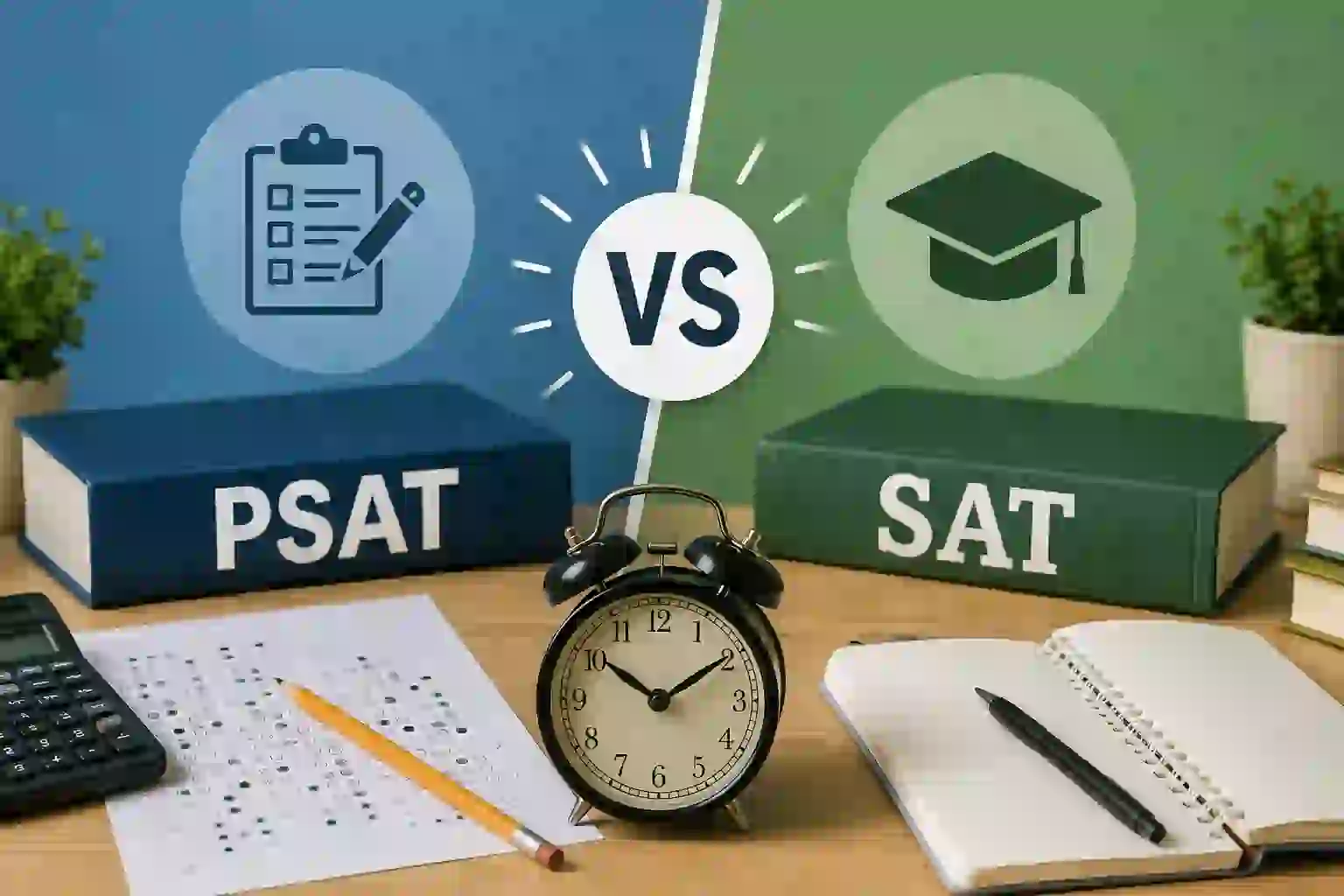
This guide breaks down everything you need to know about the PSAT vs SAT, and explains how targeted PSAT tutoring and SAT tutoring can give your child a meaningful advantage on both.
What Is the PSAT?
The PSAT — which stands for Preliminary SAT — is officially known as the PSAT/NMSQT (National Merit Scholarship Qualifying Test). It is administered by the College Board and is typically taken by students in 8th, 9th, 10th, or 11th grade, depending on the version.
PSAT 8/9:Designed for 8th and 9th graders, this version introduces students to the College Board test format at an earlier, more foundational level.
PSAT 10:Taken by 10th graders, it is slightly more advanced and helps students gauge their readiness for future SAT preparation.
PSAT/NMSQT:The most well-known version, typically taken in 10th or 11th grade. This is the version that qualifies students for the National Merit Scholarship Program, one of the most prestigious academic recognition programs in the US.
The primary purpose of the PSAT is to serve as a practice run for the SAT while simultaneously identifying high-achieving students who may qualify for National Merit recognition and scholarship opportunities.
What Is the SAT?
The SAT is the College Board's flagship college admissions test, taken primarily by 11th and 12th graders. Unlike the PSAT, the SAT carries real stakes — scores are submitted to colleges as part of the admissions process and can influence scholarship eligibility, program placement, and even financial aid.
The SAT is currently administered in a digital adaptive format, meaning the difficulty of questions adjusts based on how a student is performing. This makes strategic preparation even more important, since understanding how the test adapts can help students maximize their score.
PSAT vs SAT: The Key Differences
Here is a side-by-side look at how the two tests compare across the factors that matter most:
| Factor | PSAT/NMSQT | SAT |
|---|---|---|
| Who Takes It | 8th–11th graders | 11th–12th graders |
| Purpose | Practice + National Merit qualification | College admissions |
| Total Score | 320–1520 | 400–1600 |
| Reading & Writing | 2 sections, 54 questions | 2 sections, 54 questions |
| Math | 2 sections, 44 questions | 2 sections, 44 questions |
| Total Time | ~2 hours 14 minutes | ~2 hours 14 minutes |
| Affects College Admissions | No | Yes |
| National Merit Eligibility | Yes (PSAT/NMSQT only) | No |
| Adaptive Format | Yes (digital) | Yes (digital) |
| Calculator Policy | No calculator (Module 1 Math) | No calculator (Module 1 Math) |
Scoring: What the Numbers Mean
Knowing the scoring difference matters.The PSAT/NMSQT tops out at 1520, while the SAT tops out at 1600. This isn't just a slight adjustment — it reflects the fact that the PSAT is intentionally designed to be somewhat less demanding than the SAT, both in the depth of content and the complexity of questions.
On the PSAT, the highest possible section scores are 760 each for Math and Reading & Writing. On the SAT, each section goes up to 800. A student who scores 1400 on the PSAT should not automatically expect to score 1400 on the SAT — the gap in difficulty means SAT scores can often come in lower without targeted preparation.
Content: Closer Than You Think
The core skills are the same.Both tests assess the same three core areas: Reading & Writing and Math. The skills being measured — reading comprehension, grammar and language use, algebra, data analysis, and advanced math — are essentially the same. This is by design. The College Board structured the PSAT to mirror the SAT so that students who take the PSAT are genuinely building skills they will use on the SAT.
However, the SAT includes more advanced math questions, particularly in areas like:
- Systems of equations and more complex algebraic reasoning
- Trigonometry and geometry at a higher level of difficulty
- Data analysis questions with more nuanced interpretation requirements
The Reading & Writing sections on the SAT also tend to feature more complex passages and tighter time pressure. Students who find the PSAT reading section manageable may still find the SAT section more demanding.
Stakes: This Is the Big One
The PSAT has no college stakes.The most important difference is what each test is for. The PSAT does not go to colleges. A poor PSAT score has no direct impact on your child's admissions prospects. This makes it an excellent low-stakes opportunity to experience real test conditions, identify weak areas, and build confidence.
The SAT, on the other hand, is submitted as part of college applications. A strong SAT score can open doors to competitive programs, merit-based scholarships, and financial aid packages. The pressure is real, and students who walk into the SAT without proper preparation often underperform relative to their actual ability.
Why PSAT Performance Is a Direct Indicator of SAT Readiness
The PSAT is your diagnostic tool.One of the most valuable things about the PSAT is that it gives students and families a concrete early signal of where they stand. If your child scores well on the PSAT, it's a strong indicator that they're on track for SAT success. If they struggle, it's a clear and timely signal to invest in structured PSAT prep before the stakes get higher.
Think of it this way: A student who receives their PSAT score report and reviews it carefully — section by section, question by question — gains far more from the test than a student who glances at the total score and files it away. Every wrong answer on the PSAT is information about what drives PSAT success. It points directly to a skill gap that, if addressed through focused PSAT prep, can be closed well before the SAT arrives.
How PSAT Tutoring Builds the Foundation for SAT Success
Start early with the right support.The most effective approach to SAT preparation doesn't start in 11th grade. It starts the moment a student takes the PSAT.
Structured PSAT tutoring goes well beyond simply reviewing content. A good PSAT tutor works with a student to:
Diagnose skill gaps early.After reviewing PSAT results, a tutor identifies whether weaknesses lie in specific math concepts (like data analysis or advanced algebra), reading comprehension, grammar, or time management. Knowing where the gaps are — rather than guessing — allows preparation to be highly efficient.
Build section-specific strategies.The PSAT and SAT reward students who understand how the questions are structured, not just students who know the content. A tutor experienced in PSAT prep teaches students to recognize question patterns, eliminate wrong answers methodically, and approach each section with a clear plan.
Develop pacing habits.One of the most common reasons students leave points on the table is poor time management. The digital adaptive format of both tests means that early performance influences the difficulty of questions that follow. Students who rush through early questions and make avoidable errors can find themselves locked into a lower difficulty module — regardless of their actual capability. PSAT tutoring builds the pacing habits that prevent this.
Reduce test anxiety.For many students, the PSAT is their first experience with a standardized test in a formal setting. Working with a tutor before and during PSAT prep reduces anxiety by building familiarity and confidence. A student who has practiced under timed, realistic conditions enters the test room prepared rather than apprehensive.
At Jaya's Academy, our online PSAT tutoring program covers all sections of the test — Math, Reading, and Writing & Language — with 1-on-1 instruction tailored to each student's pace and performance data. Students work through authentic PSAT-style questions, receive detailed feedback session by session, and develop the study habits that carry directly into SAT preparation.
How SAT Tutoring Takes It Further
Building on PSAT foundation.Once a student has built a strong foundation through PSAT preparation, SAT tutoring focuses on advancing those skills to meet the higher demands of the SAT.
The transition from PSAT to SAT preparation involves:
Deepening math knowledge.The SAT introduces math concepts and question complexity that go beyond the PSAT. Students who excelled in PSAT math may still find certain SAT math question types challenging, particularly those involving advanced functions, trigonometry, or multi-step word problems. Learn more about comprehensive SAT prep strategies, with targeted SAT math tutoring to bridge this gap systematically.
Sharpening reading and writing precision.SAT reading passages are longer, more complex, and require more precise interpretation. In writing, the SAT tests the same grammar and style skills as the PSAT but at a higher level of accuracy. SAT tutoring hones the ability to read efficiently and choose answers with precision rather than instinct.
Mastering the adaptive format.Both the PSAT and SAT use an adaptive digital format, but the SAT's adaptive nature has more significant consequences. Performing strongly in the first module unlocks harder — and higher-scoring — questions in the second. A student who understands this dynamic and prepares for it through simulated adaptive practice is at a distinct advantage.
Full-length practice under real conditions.One of the most effective components of SAT preparation is completing full-length timed practice tests under conditions that mirror the real exam. Jaya's Academy's SAT online tutoring program incorporates timed practice tests, post-test analysis, and targeted review sessions to ensure students improve consistently across every sitting.
A Smart Two-Phase Preparation Timeline
Planning for success.Understanding the relationship between the PSAT and SAT makes it possible to plan a comprehensive two-phase preparation strategy that builds progressively toward the student's best possible SAT score.
Phase 1: PSAT Preparation (Grades 9–10)The goal here is foundational. Students should focus on understanding the test format, strengthening core academic skills, and practicing under timed conditions. Beginning PSAT tutoring two to three months before the test date allows enough time to address skill gaps and build confidence without creating unnecessary pressure.
After taking the PSAT, students should review their score report carefully with their tutor. The sub-scores and question-level data are a roadmap for Phase 2.
Phase 2: SAT Preparation (Grade 11, ideally starting 4–6 months before the target test date)With PSAT results and a clear picture of strengths and weaknesses in hand, SAT tutoring can be highly targeted from the start. Rather than reviewing everything from scratch, a student who completed Phase 1 properly arrives at SAT prep already familiar with the format, already practiced in time management, and already aware of their specific weak spots.
This sequential approach consistently produces stronger SAT outcomes than beginning SAT prep cold in junior year without the benefit of earlier PSAT preparation.
Does a Strong PSAT Score Matter Beyond the Test Itself?
National Merit recognition is valuable.For most students, the PSAT score itself does not affect college admissions. However, students who score in the top percentile on the PSAT/NMSQT — known as the Selection Index — may qualify for the National Merit Scholarship Program. Each year, approximately 50,000 students are recognized as Commended Scholars, Semifinalists, or Finalists, with Finalists eligible for scholarships worth up to $2,500 or more from sponsoring organizations and colleges.
The Selection Index cutoff varies by state and changes year to year. In many competitive states, a student typically needs to score around 1400–1500 out of 1520 to be a strong Semifinalist candidate. For students with National Merit aspirations, beginning focused PSAT prep as early as 9th grade gives them the longest possible runway to reach that level.
Even for students not pursuing National Merit recognition, a strong PSAT score is a confidence booster, a useful data point for college planning, and an early confirmation that SAT preparation is on the right track.
Common Mistakes Students Make When Preparing for Both Tests
Avoid these pitfalls.Understanding where students typically go wrong helps families avoid the same mistakes.
Treating the PSAT as unimportant.Some students walk into the PSAT without any preparation, treating it purely as a formality. While it's true that PSAT scores don't go to colleges, taking the test without any preparation squanders the diagnostic value. Even minimal PSAT prep dramatically increases the usefulness of the results.
Assuming PSAT preparation automatically transfers to the SAT.The PSAT and SAT are closely related, but the SAT's higher difficulty requires active upward adjustment. Students who plateau after PSAT prep without continuing to develop their skills often find the SAT harder than expected.
Focusing only on content, not strategy.Both tests reward students who understand how to approach questions strategically — not just students who know the underlying content. Memorizing formulas isn't enough if a student can't identify which formula to apply quickly and accurately under time pressure.
Starting SAT preparation too late.Beginning SAT tutoring just a few weeks before the test is one of the most common and costly mistakes. Meaningful score improvement takes time. A structured preparation timeline of four to six months, supported by consistent online SAT tutoring, produces far better outcomes than any last-minute cramming approach.
How Jaya's Academy Supports Both PSAT and SAT Preparation
Expert guidance for both tests.At Jaya's Academy, we've been helping students across the US navigate standardized test preparation since 2011. Our 1-on-1 online PSAT tutoring and SAT online tutoring programs are built around each student's individual performance data, learning pace, and target scores.
Every student who works with us benefits from:
- A personalized study plan built around their specific strengths and weak areas
- Section-by-section instruction covering all PSAT and SAT content areas
- Timed practice with authentic test-style questions and real-time feedback
- Pacing strategies and test-day readiness training
- Continuous progress tracking so students and parents always know where they stand
Whether your child is preparing for the PSAT for the first time, working toward National Merit recognition, or aiming for a top SAT score for college admissions, our experienced tutors are ready to guide them every step of the way.
Next Steps: Get Your Child Prepared
Ready to get started? Contact Jaya's Academy today to schedule a free demo session and find out how our personalized 1-on-1 tutoring can help your child succeed on the PSAT and SAT.