


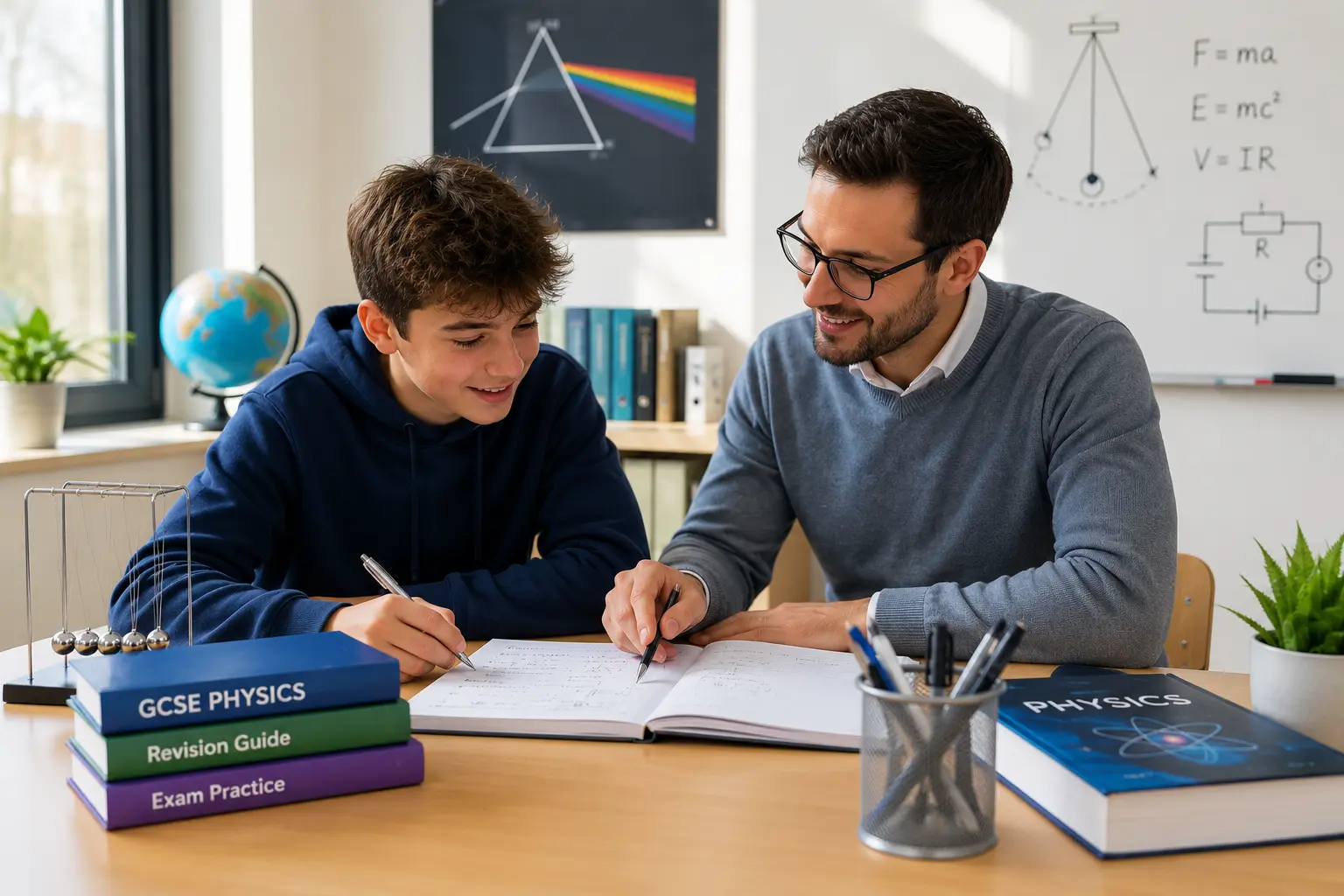
GCSE Physics: A Subject Where Small Gaps Become Big Problems
GCSE Physics has a reputation for being one of the hardest subjects on the syllabus, and for good reason. Unlike subjects that reward memorisation alone, Physics demands that students understand a concept, recall the correct formula, apply it accurately in an unfamiliar context, and show their working to exam board standards, all under timed conditions. A student who is a little shaky on one topic, such as moments, circuits, or wave equations, often finds that gap resurfaces again and again across the paper, because Physics questions frequently link several topics together. This is why students who seem to understand the subject in class can still underperform on results day. A GCSE Physics tutor's job is to find those small gaps early and close them before they compound into a lower grade than the student is capable of.
Why GCSE Physics Feels Harder Than Other Sciences
Physics leans more heavily on mathematics than Biology or Chemistry, requiring students to be comfortable rearranging equations, working with standard form, and interpreting graphs, on top of understanding the physics itself. It also covers a wide spread of content, from forces and energy to electricity, waves, magnetism, and particle physics, so there is less room to specialise and more content to keep fresh for the final exams. Many topics are also genuinely abstract, such as electromagnetic induction or nuclear decay, and are hard to picture without a clear explanation and worked examples. A skilled physics tutor breaks these abstract ideas into concrete steps, connecting the maths to the physics so that formulas stop feeling like things to memorise and start feeling like tools the student understands.
The Exam Technique Gap: Knowing It vs Scoring It
One of the most common issues tutors see is a student who understands a topic in conversation but loses marks on the exam paper. GCSE Physics papers are marked against strict mark schemes, and command words like 'state', 'explain', 'calculate', and 'evaluate' each require a different style of answer. A student who writes a correct idea in the wrong format, skips a required unit, or fails to show their method for a calculation can lose marks despite understanding the physics perfectly well. Tutors spend significant time on exam technique specifically: how to structure a six-mark extended response, how to show working so that method marks are awarded even if the final answer is wrong, and how to manage time across a paper that mixes short recall questions with longer application questions.
How a GCSE Physics Tutor Closes the Gap
Effective tutoring starts with identifying exactly where a student's understanding breaks down, rather than re-teaching the whole syllabus from scratch. A tutor works through past paper questions with the student, and when a mistake appears, digs into whether it was a physics misunderstanding, a maths error, or a misreading of the question, then targets practice at that specific weakness. Because GCSE Physics tutoring is one-to-one, the pace adjusts to the student rather than the class, so a student can spend an extra session on electricity if that is where they are weakest, without falling behind on other topics. Regular retrieval practice and spaced repetition of earlier topics also help make sure that content learned in Year 10 is still fresh by the time of the Year 11 exams.
Required Practicals and the 9-1 Grading System
Under the current GCSE specifications, students are expected to understand the required practicals in detail, including apparatus, method, sources of error, and how to improve an experiment, since exam questions frequently draw on this practical knowledge even when the exam itself is not practical-based. The 9-1 grading system has also raised the bar at the top end, with grades 7 to 9 requiring a level of precision, evaluative thinking, and mathematical fluency that goes beyond simply knowing the content. A tutor who understands exactly what separates a grade 6 answer from a grade 8 answer can show a student precisely what needs to change in their exam responses to move up a grade boundary.
Building Confidence Before Mock and Final Exams
Physics anxiety is real, and many capable students underperform simply because they freeze on unfamiliar question wording or panic when a calculation does not go as expected. Regular one-to-one sessions build familiarity with the exam format, so that by the time mocks and final exams arrive, very little on the paper feels genuinely new. Tutors also track a student's progress across topics, so parents can see concretely where their child has improved and where focus is still needed, which keeps preparation structured rather than last-minute and stressful.
What to Look for in a GCSE Physics Tutor
When choosing a GCSE Physics tutor, it is worth prioritising someone with genuine subject expertise, familiarity with the specific exam board your child is sitting, whether AQA, Edexcel, or OCR, and a track record of moving students up through the grade boundaries. A good tutor should also be able to explain concepts in more than one way, since a method that works for one student may not click for another, and should give regular, specific feedback rather than vague encouragement.
Final Thoughts
GCSE Physics rewards precision, practice, and a genuine understanding of how concepts connect, and most students who struggle are not lacking ability, they are lacking the targeted support needed to close specific gaps before exam day. With the right GCSE Physics tutor, students can turn a subject that feels overwhelming into one where they walk into the exam hall with confidence and a clear plan for every question type.
Physics rewards precision and practice, and most students who struggle just need the right targeted support to close their specific gaps.
What a Personalised GCSE Physics Tutoring Plan Includes
- Topic-by-topic gap analysis
- Required practical walkthroughs
- Exam-board specific past papers (AQA, Edexcel, OCR)
- Command word and mark scheme training
- Regular progress reviews for parents
Ready to Help Your Child Aim Higher in GCSE Physics?
Want to know more about how your child can benefit from our online GCSE Physics tutoring? Call +44 113 543 1454 or write to info@jayasacademy.com.


